Example · Storage
Elfa: storage planned in 3D
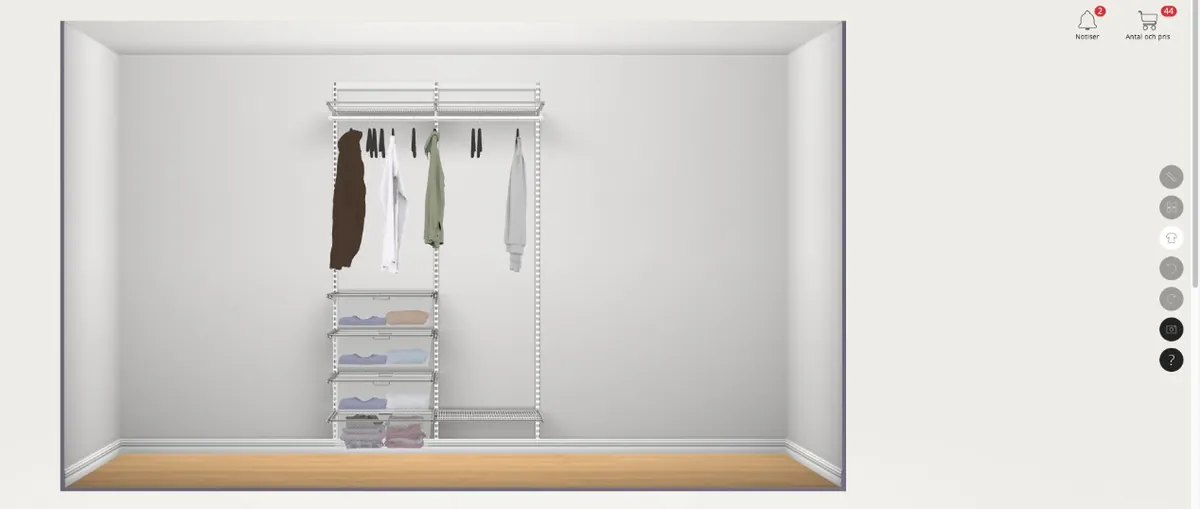
Elfa’s customers draw their wardrobe or bookcase in the browser, drag in products from the range and get an order list. An example of a spatial configurator for consumers.
| Company | Elfa, storage systems and made-to-measure sliding doors |
| Type of configurator | Spatial configurator in 3D |
| Users | Consumers online |
| Result | Order list and quote |
| Built by | Animech |
The problem
Elfa’s range consists of many parts that can be combined into anything from a simple bookcase to a complete wardrobe. It is flexible, but hard for a consumer to grasp. Which rails, shelves and baskets are needed, and will they fit in this particular space?
Choices and rules
The customer starts with an empty room or a ready-made solution and drags in products from a library. The products are placed in a photorealistic environment, and the tool keeps track of how the parts fit together. The customer does not need to know the range to get a solution that works.
After the configuration
When the solution is ready, the tool generates an order list with all the parts, and the customer can get a quote. That turns the plan into a brief that can be bought directly or taken to a retailer.
The flow
From empty wall to order list
- The customer chooses a room or a ready-made solution.
- Products are dragged in and placed in 3D.
- The tool calculates all the parts.
- The result is an order list and a quote.
What others can learn
- For modular products, the parts list is as important as the image.
- Ready-made solutions to start from lower the threshold for inexperienced users.
- The tool must work for people with no experience of design or computer tools.
The example was built by Animech, which runs konfigurator.nu. The description is based on public information about the project and on how the tool works today.