Pricing & business value
What does a configurator cost and how do you calculate the value?
What a configurator costs depends less on the technology and more on product data, rules, integrations and visualisation. Here are the cost drivers, how to compare quotes and how to calculate the value.
In short
- Four things drive the cost the most: rules, product data, integrations and visualisation.
- Compare quotes on total cost over several years, not just the build.
- Calculate the value based on what can be measured today: time per quote, incorrect orders and conversion.

Contents
What drives the cost?
1. Rules and logic
The number of choices and how they depend on each other. A few dozen variants with simple choices is something completely different from thousands of combinations where one choice affects several others.
2. Product data
If variants, prices and rules are already structured in ERP or PIM, it goes quickly. If they have to be collected from Excel, documents and specialists, it is often the biggest item, and it sometimes ends up outside the quote.
3. Integrations
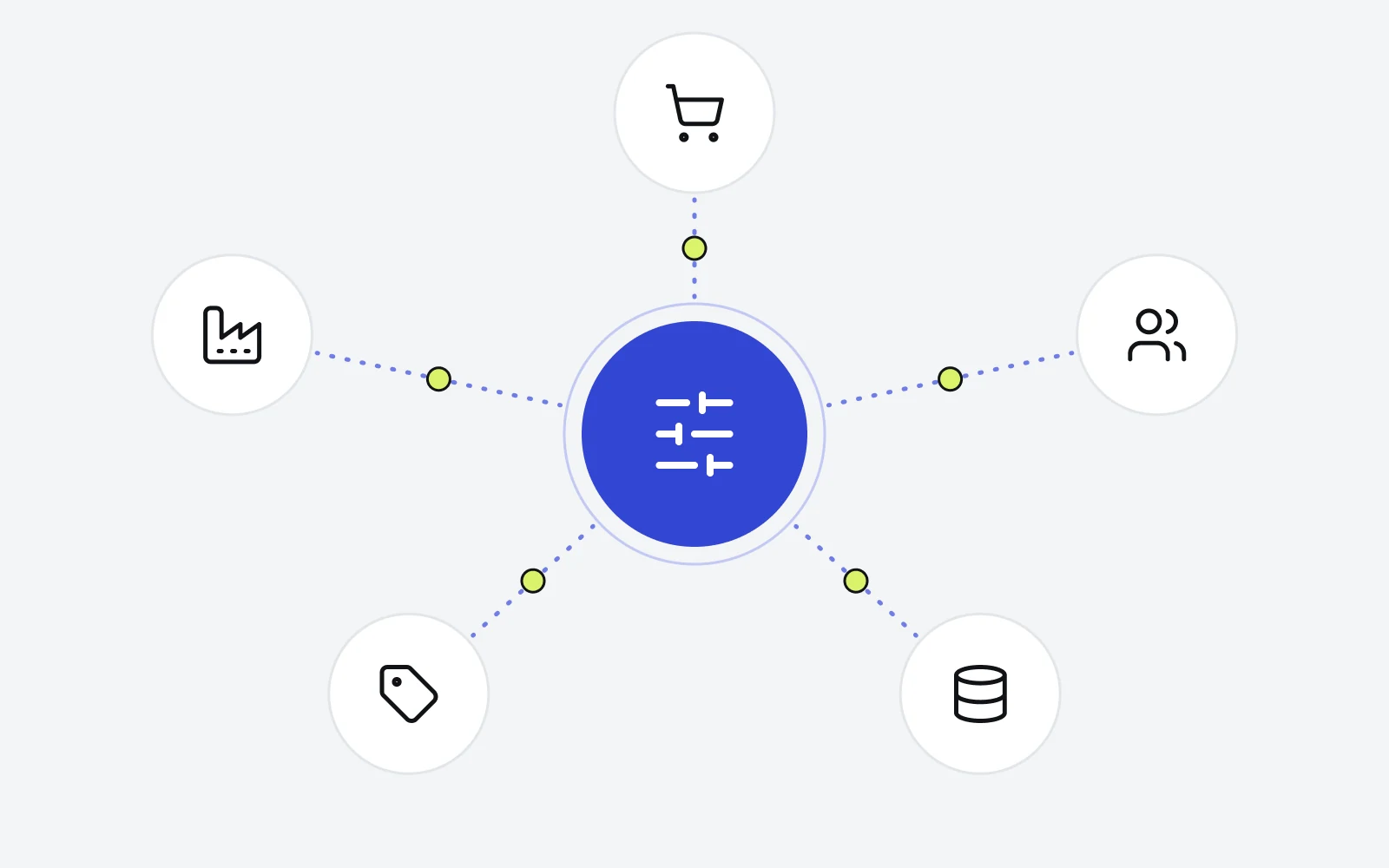
Every system the configurator needs to talk to costs money: online shop, CRM, ERP, PIM or production. Ask who builds and maintains the connections, and what happens when a system is upgraded.
4. Visualisation
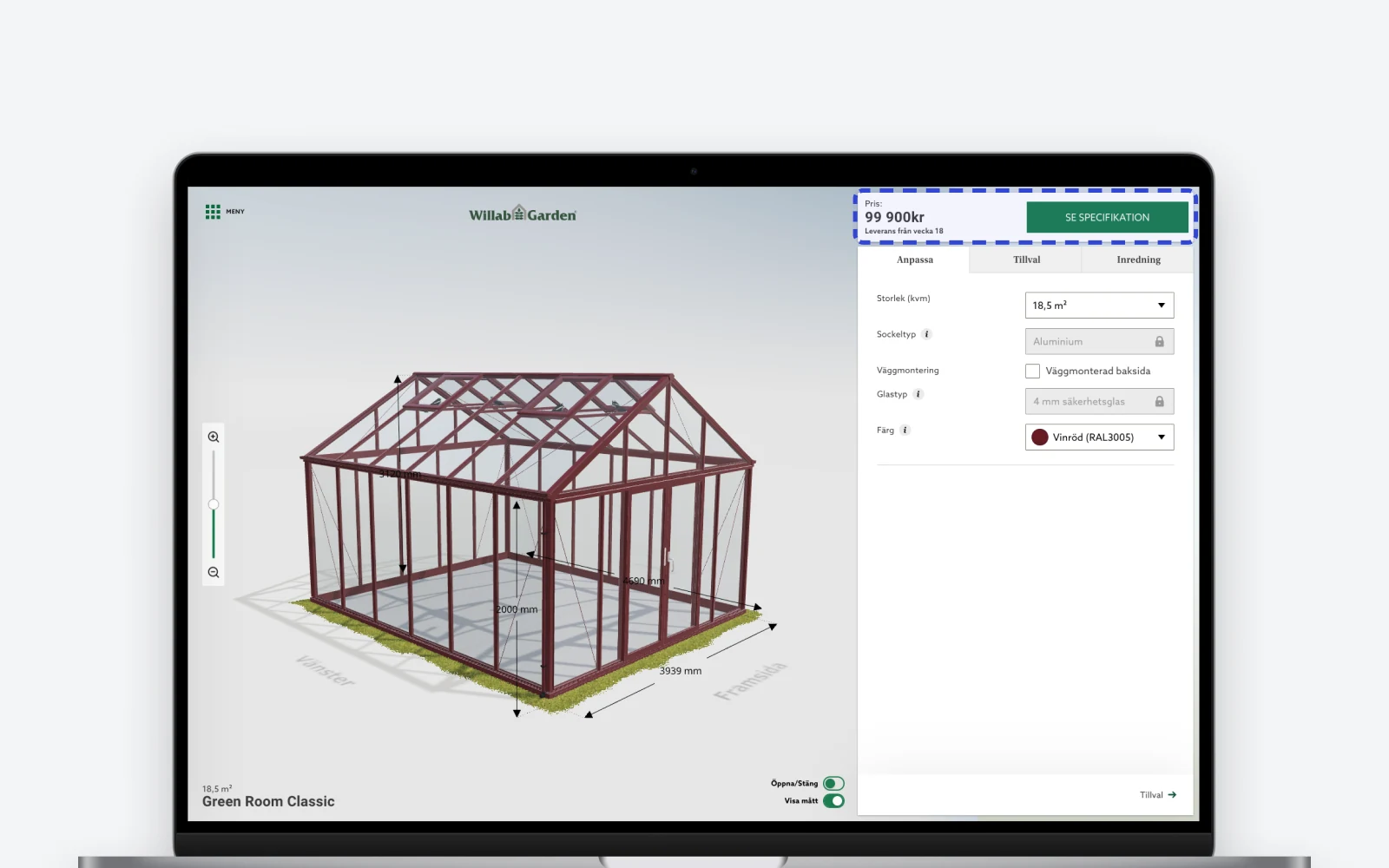
Images, 2D drawings or 3D. In 3D it is mainly the number of parts and materials to be modelled, and the quality level, that drives the cost. Also ask what each new product costs to add.

5. Operation, licences and maintenance
Licences per user or per year, hosting, support and time to update rules and prices. This is where the difference between solutions often becomes greatest over time.
Compare quotes
The same questions to every supplier
Ask each supplier to break down their price like this. Then the quotes can be compared.
| Item | Question to ask | One-off or ongoing |
|---|---|---|
| Start-up and analysis | What is included in the analysis of product logic and flow? | One-off |
| Product data | Who structures the data, and how many hours do you estimate? | One-off |
| Rules and logic | How many rules are included, and what do more cost? | One-off |
| Integrations | Which systems are included, and who maintains the connections? | Both |
| Visualisation | How many products and materials are included? What does a new product cost? | Both |
| Licence and operation | What does it cost per year, and what happens if we grow? | Ongoing |
| Maintenance | Can we change rules and prices ourselves, and what does help cost? | Ongoing |
How to calculate the value
A configurator usually adds value in three ways. Calculate based on what you can measure today, and be careful with assumptions.
Time in the sales process
How long does a quote take today, and how many quotes are made per year? The time saved per quote, times the number of quotes, times the hourly cost, gives a first figure. Also count the specialists’ time, which is often the scarce resource.
Fewer errors
What does an incorrect order, a complaint or a change after ordering cost? How many happen per year? The configurator can reduce errors caused by combinations that cannot be delivered, when the rules are correctly modelled and tested.
Sales
The hardest to calculate in advance. Start from current conversion and average order, and calculate several scenarios instead of one. Set up measurement from the start, so you can follow the outcome.
Simple model
Annual value = (hours saved per quote × number of quotes × hourly cost) + (errors avoided × cost per error) + (increased sales × margin)
Payback time = one-off cost ÷ (annual value − ongoing cost per year)
A worked example (illustrative)
The figures are made up to show how the model works. They are not a price or an outcome from a real project.
- 2,000 quotes per year × 0.5 hours saved × SEK 700 per hour = SEK 700,000 in annual time value.
- A one-off cost of SEK 1,000,000 and an ongoing cost of SEK 200,000 per year gives an annual net value of SEK 500,000.
- Simple payback time: 1,000,000 ÷ 500,000 = two years, if the full time value is realised.
Keep in mind that freed-up time does not automatically become a cost saving: it only becomes valuable when it is used for something else, such as more deals. The calculation also ignores the implementation period and discounting. If the annual net value is zero or negative, there is no payback time in the model.
Calculate your own business value
Enter your own figures for quoting and order errors. The calculator updates instantly and shows what a configurator could be worth per year for you, based on your assumptions.
Example values. Replace them with your own figures. We have no general percentages to give, so the shares are your own assumptions.
Estimate per year
- Time saved in quoting
- Incorrect orders avoided
- Total per year
- Payback time
The calculation is based entirely on your figures and assumptions. It says nothing about what a particular solution costs.
Frequently asked questions
What does a configurator cost?
The range is wide, from a simple product configurator to an integrated visual CPQ for an entire range. A serious answer requires someone to have seen your product logic and which systems need to be connected. Ask for a price broken down according to the table above.
Is a licence or a one-off price better?
It depends on how long you will use the solution and how much it will change. Compare the total cost over three to five years, including maintenance.
How do we show the value to management?
Start with the figures you already have: time per quote, number of quotes and the cost of errors. That gives a cautious calculation that holds up, and the sales effect becomes a bonus.
Sources and further reading
- Configure, price and quote (Wikipedia)
- Upphandlingsmyndigheten (Swedish National Agency for Public Procurement)