Compare solutions
Compare solutions
Product configurator, CPQ, 3D or a simpler form? Here is a comparison of the solution types, and a way of working to figure out what you need before you talk to suppliers.
In short
- Start with who will use the solution and what should happen after the last choice, not with the technology.
- The product data often decides more than the choice of supplier.
- Sometimes the right answer is a simpler solution, or structuring the offering first.
Comparison
Contents
The solution types side by side
Compare what decides the choice: who makes the choices, what the buyer needs to know, which result should be created and who maintains the solution.
| Solution | Who makes the choices | What the buyer needs to know | Result | Systems affected | Who maintains it | Speaks against |
|---|---|---|---|---|---|---|
| Form or product page | The buyer | Knows which product they want | Order or request | Online shop or email | Web editor | The combinations become many or errors become costly |
| Product configurator | The buyer | Roughly knows what they want | Order or request | Online shop, ERP | Product manager owns the rules | The buyer only knows the need |
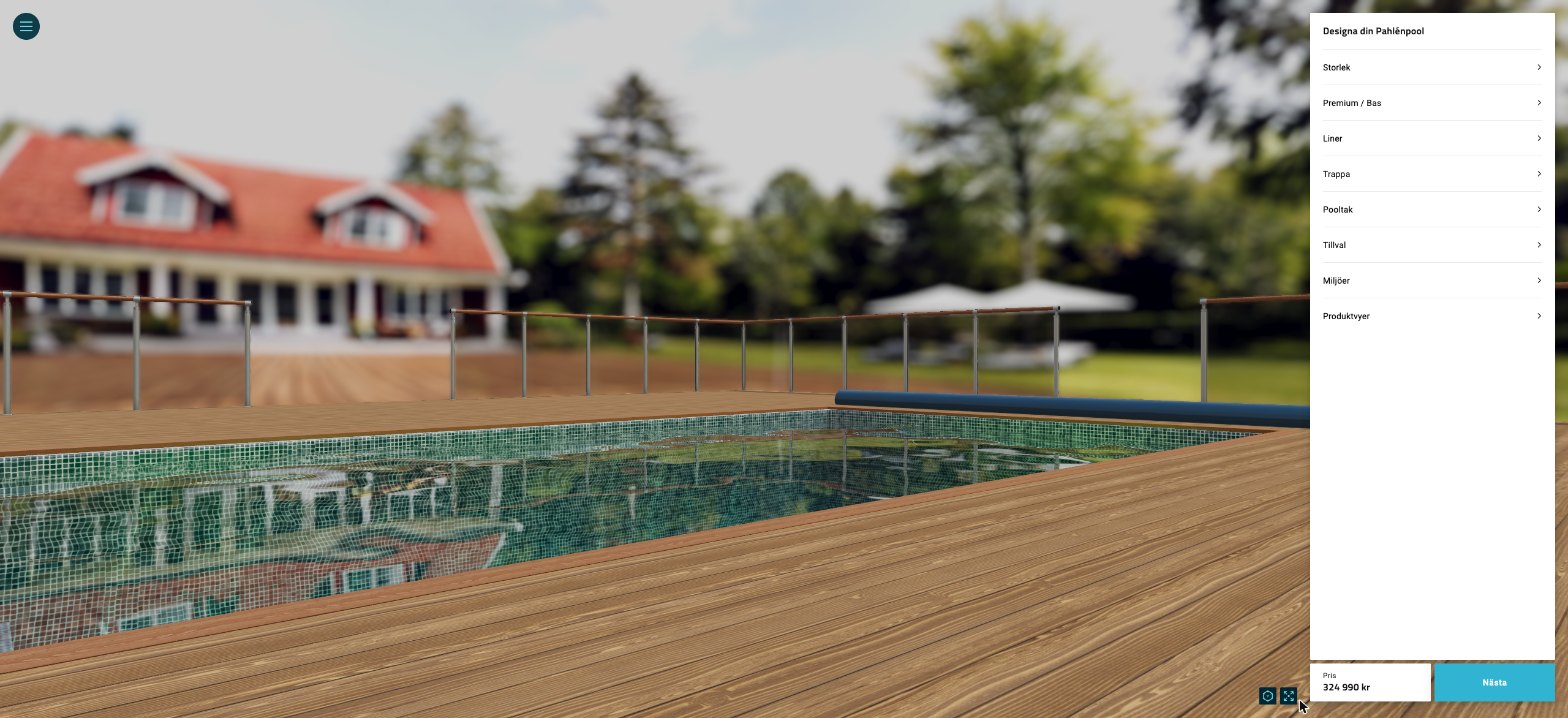
| 3D configurator | The buyer | Needs to see the result to understand it | Order or request | Online shop, ERP, 3D models | Product manager and the 3D modeller | The choices are not visible, or images are enough |
| Sales configurator / CPQ | Salespeople, partners, sometimes the buyer | Knows the need, not the range | Quote with customer price | CRM, ERP | Sales and product own rules and prices | Every deal is engineered from scratch |
| Visual CPQ | Salesperson and buyer together | Knows the need and needs to see the solution | Quote with images | CRM, ERP, 3D models | As CPQ, plus visual models | The product is bought on specification |
| Room planner | The buyer or a salesperson in store | Knows their room and its dimensions | Parts list or order | Online shop, ERP | Product manager, rules for product and room | The product stands on its own |
Examples of reasonable first versions
- E-commerce: one product family with rules and prices in the online shop. No 3D and no ERP connection for orders in the first step.
- Sales support: needs questions and quotes for one market, connected to CRM. Pricing rules for standard discounts, exceptions approved manually.
- Existing CPQ: a visual interface for one product line on top of the system you already have, where the rules stay.
Five steps before you choose a supplier
- Describe the user and the flow. Who makes the choices, where, and what happens after the last choice? An order in ERP places different demands than a PDF for the customer.
- Review the product data. Where are variants, rules and prices today? If the answer is ”in the heads of a few specialists”, that is where the work begins.
- Limit the scope of a first version. Choose one product family or one market to go first. That gives faster learning and lower risk.
- Write the requirements as questions. How do we change a rule? How is the quote connected to CRM? Who owns the 3D models? The questions reveal more than a list of features.
- Ask for a pilot or demo on your products. A demo on the supplier’s own examples says little about how your product logic works.
Build it yourself, standard platform or specialist?
Build it yourself
Gives full control and fits when configuration is core to the business and you have developers who can maintain it. The risk is that the rules end up in the code and become expensive to change.
Standard platform
CPQ and configurator platforms provide a ready-made rules engine, pricing and integrations. They fit when the needs resemble what the platform is built for. Customisations and licences can become expensive over time.
Specialist or agency
Fits when the experience, 3D or unusual product logic is decisive. Ask how the rules are maintained after launch, and whether you can change them yourselves.
Konfigurator.nu is run by Animech, which is such a specialist. That is worth knowing when you read the comparison.
Frequently asked questions
How long does it take to arrive at the right solution?
Often a few weeks of internal work on users, flow and product data. That work is needed whichever solution you choose, and makes the supplier dialogue much shorter.
Can we start small?
Yes, and it is recommended. One product family or one channel is enough to see whether the solution works and what it delivers.
What is the most common mistake?
Choosing technology before knowing who will use the tool and what should happen after the last choice. The second most common is underestimating the work on the product data.
Sources and further reading
- Configure, price and quote (Wikipedia)
- Upphandlingsmyndigheten (Swedish National Agency for Public Procurement)