In short
- Choose visualisation based on what the buyer needs to see to dare to order.
- Images are enough when the variants are few and the differences are clearly visible.
- 3D makes the most difference for modular products, dimensions and assembly.
The question of 2D or 3D is rarely decided by the technology. It is decided by what the buyer needs to see to dare to order, and by how many combinations there are.
Contents
Three levels of visualisation
Images
Photographs or rendered images of the variants. Good-looking, proven and fast for the customer. Works as long as the number of combinations is small, since each combination needs an image.
2D
Drawings, plan views or layered images placed on top of each other. Good for technical products where dimensions and placement matter more than the feel, and for planning on a floor plan, such as kitchens or warehouses.
3D
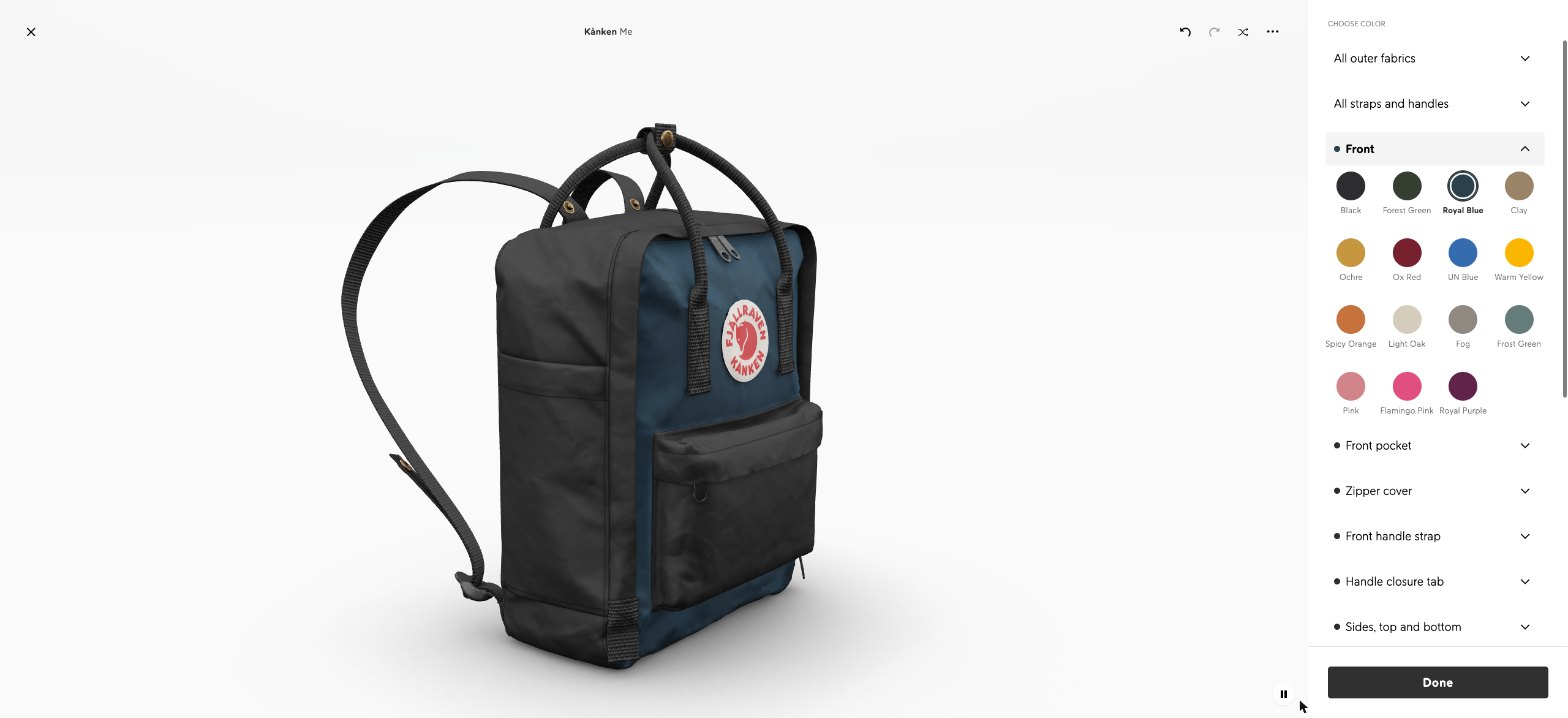
A model built up from the customer’s choices that can be rotated and zoomed. Makes it possible to show every combination without photographing each one. Requires models of all parts and materials.
When are images enough?
- The product has few variants, for example a few colours and sizes.
- The customer buys on feel and wants to see the product in a setting.
- The choices are not visible, such as performance, software or certifications.
When does 3D make a difference?
- The product is built from modules, and the number of combinations is too large for images.
- The customer needs to understand dimensions, proportions or how parts fit together.
- Wrong choices are costly, and a clear image reduces the risk of misunderstandings.
- The same models can be used in quotes, marketing, AR and service.
Comparison
| Images | 2D | 3D | |
|---|---|---|---|
| Many combinations | Fits less well | Depends | Fits well |
| Shows dimensions and assembly | Fits less well | Fits well | Fits well |
| Feel and materials | Fits well | Fits less well | Depends |
| Cost to get started | Fits well | Fits well | Depends |
| Cost per new variant | Depends | Fits well | Fits well |
Questions to ask yourselves
- What does the buyer need to see to dare to order?
- How many combinations are there, and how many are added per year?
- Are there CAD models that can be reused?
- Should the images also be used in quotes, catalogues or marketing?
- Which devices do the buyers use, and how fast is their connection?
A made-up example: two products, two answers
A company sells two product lines. The first is office chairs in eight colours and three armrest variants, that is 24 combinations. The second is a modular storage system where the customer builds their own sections with thousands of possible combinations.
For the chairs, photographed images are enough. They are few, they look better than a web model, and the customer buys on feel. For the storage system it is not possible to photograph every combination, and the customer needs to see whether the sections fit together and fit in the space. That is where 3D makes a difference, and the same models can be used in the quote and in the store’s planning tool.
It is common for the same company to need different answers for different products. That is a reason to choose a solution where rules and visualisation are kept apart, so that each product line can be shown in the way that suits it.
Frequently asked questions
Can we start with images and switch to 3D later?
Yes, if the rules live in their own engine and are not tied to the images. That is a good reason to keep logic and visualisation apart from the start.
Can we use our CAD?
Usually as a starting point. CAD files are built for manufacturing and need to be simplified and optimised for the web.
Does 3D work on mobile?
Yes, if the models are optimised. Test on the devices your customers actually use.
What does 3D cost compared to images?
It depends on the number of products, parts and materials. Images cost per combination, 3D costs per part and material. With many combinations, 3D often becomes cheaper per variant; with few, images are cheaper.
Can the 3D models be used for other things?
Often, for example in product images, AR, quotes, assembly instructions and spare-parts catalogues. Ask the supplier who owns the models and in which formats they can be handed over.
Sources and further reading
- WebGL (Khronos Group)
- glTF, the format for 3D on the web (Khronos Group)
- Augmented reality (Wikipedia)