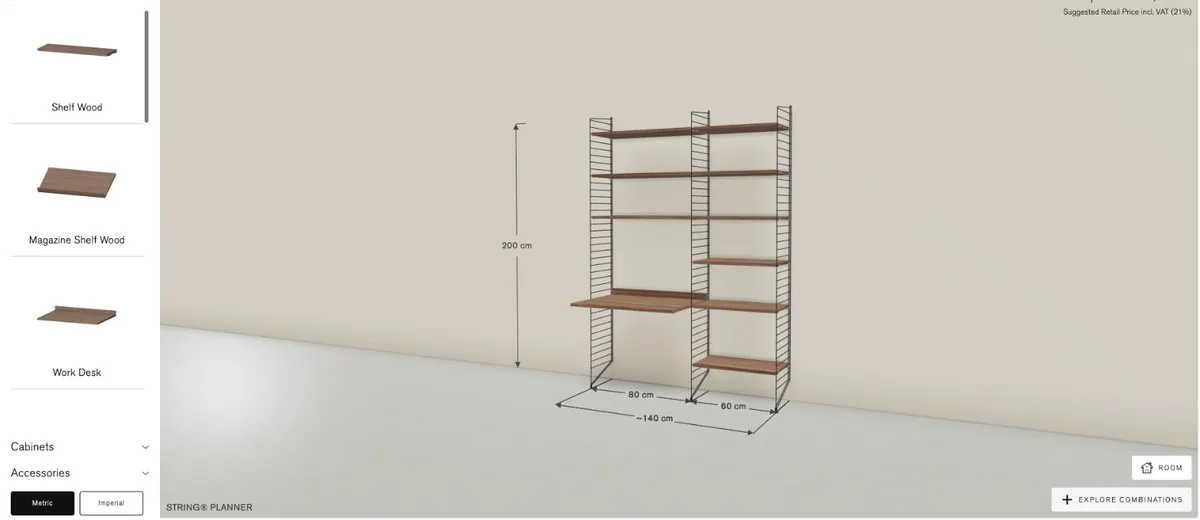
Understand configurators
Product configurator
A product configurator lets the customer choose variants of a product and makes sure the combination can be delivered. It fits when the range has many variants but clear rules.
In short
- Starts from the product: the customer chooses model, dimensions, materials and options.
- Adds the most value when there are many combinations and wrong choices are costly.
- Requires structured product data and rules that someone owns.
Contents
What is a product configurator?
A product configurator shows the choices available for a product and keeps track of which ones go together. If the customer chooses a certain size, options that do not fit disappear and the price updates. The result is a specification that can be ordered without anyone having to check it manually.
The difference from a sales configurator is the starting point. A product configurator asks which product the customer wants. A sales configurator asks what it will be used for and suggests a product.
When does a product configurator fit?
- The product comes in many variants, and it is hard to show all of them as finished items.
- The customer roughly knows what they want and wants to choose the details themselves.
- Incorrect orders lead to returns, complaints or rework.
- Salespeople or customer service spend a lot of time answering what can be combined.
When does it fit less well?
If the products are few and the variants simple, a regular product page with a few choices is often enough. If the customer does not know which product fits, for example in technical purchases, needs questions in a sales configurator may work better. And if the rules only exist in the heads of a few people, they need to be structured before anything is built.
What does it take to succeed?
Product data
All choices, variants, dimensions and prices need to be in a form the configurator can read, often from ERP or PIM. It is common for this work to take longer than the build itself.
Rules
Every dependency between choices must be described: what excludes what, what requires what and how the price is affected. Someone in the organisation needs to own the rules and be able to change them.
The flow after the last choice
Decide early what should happen to the configuration: an order in the online shop, a quote in CRM, a production order in ERP or a PDF for the customer. That determines which integrations are needed.
Questions to ask the supplier
- How do we change a rule or a price without hiring you?
- Where does the product data come from, and what happens when it changes?
- How does the configurator explain to the customer why a choice is not possible?
- What happens to the configuration after the customer is done, and which systems receive it?
- What does operation and maintenance cost per year, and what is included?
New to the topic? Start with what a configurator is and which types there are, or look up the terms in the glossary.
Frequently asked questions
What does a product configurator cost?
It mostly depends on how many rules and integrations are needed, and on whether the product data is already structured. 3D visualisation is a separate cost driver. Ask for a breakdown between build, data and ongoing operation.
Can we use it both online and internally?
Yes, and it is common. The same rules can be used by customers in an online shop and by salespeople creating quotes. That requires the rules to live in a shared engine rather than being built twice.
Does the product configurator need to show the product in 3D?
No. Many work well with images or drawings. 3D makes the biggest difference when appearance is an important part of the buying decision.