Understand configurators
Sales configurator and CPQ
A sales configurator starts from the customer’s needs rather than the product, and leads to a solution with a price. When it also creates the quote, it is often called CPQ.
In short
- Asks questions about needs, such as what the machine will be used for, and suggests a solution.
- Used by your own salespeople, dealers or customers online.
- CPQ means configure, price, quote: configuration, price and quote in the same flow.
Contents
What is a sales configurator?
A product configurator asks which model the customer wants. A sales configurator asks what it needs to handle, in what environment and with which requirements, and then calculates which products and options meet them. That means even someone who does not know the range in detail can come up with a correct solution.
Good sales configurators let the user answer in any order, show what conflicts and suggest alternatives instead of just saying no. The result is often a brief with specification, price and lead time.
Sales configurator, CPQ and visual CPQ
- Sales configurator: focus on finding the right solution based on needs.
- CPQ: adds pricing, discounts, approvals and quotes, usually connected to CRM.
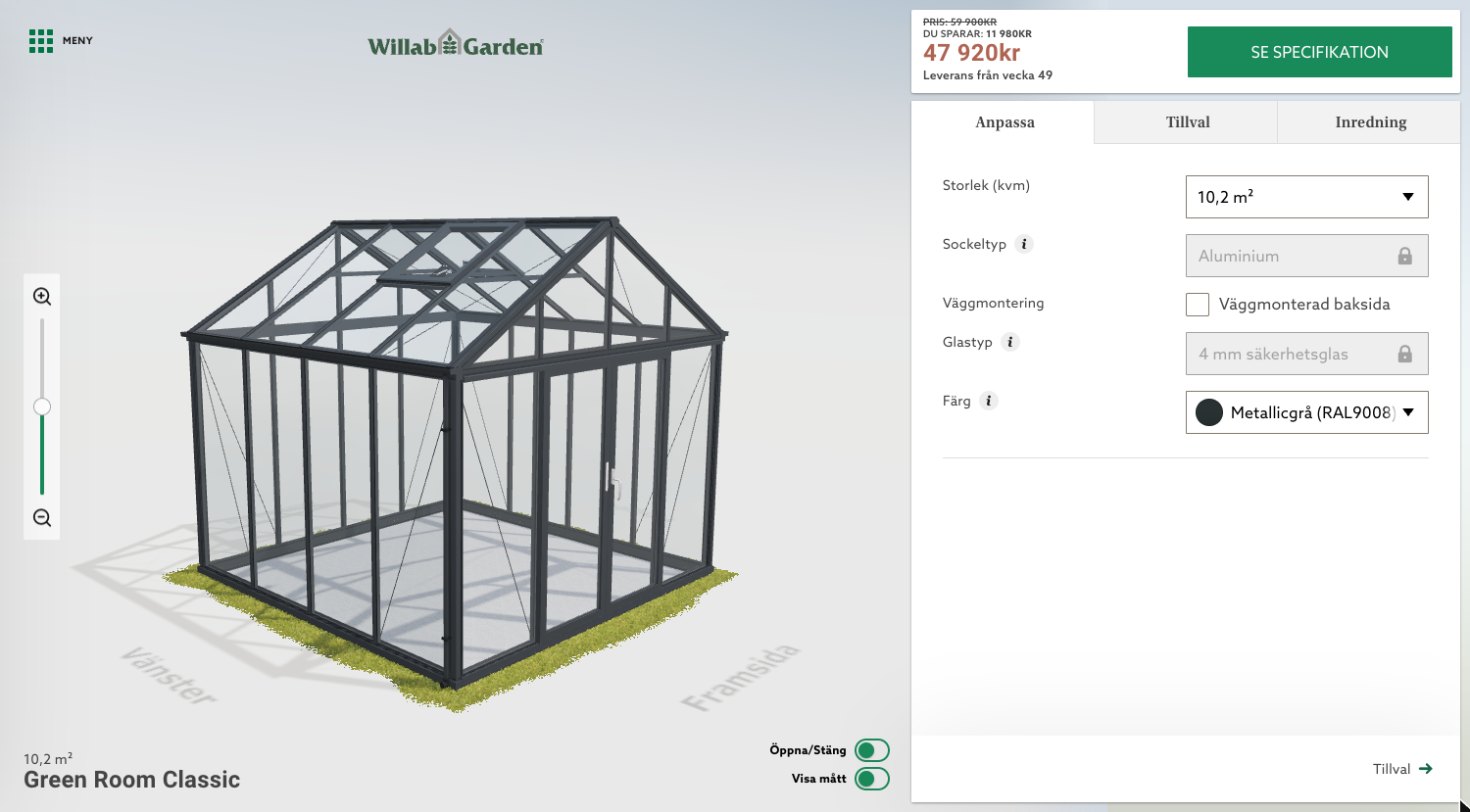
- Visual CPQ: the same flow, but the solution is shown in 2D or 3D so the customer sees what they are buying.
When does a sales configurator fit?
- The products are technical, and the customer knows the need but not which product fits.
- Quotes take a long time because specialists have to calculate or check.
- New salespeople or dealers need to be able to quote without knowing everything.
- Incorrect quotes lead to lost deals or costly changes afterwards.
When does it fit less well?
If every deal is unique and requires engineering from scratch, it can rarely be captured in rules. If the range is small and customers already know what they want, a product configurator or a price list is often enough.
What does it take to succeed?
The hard part is rarely the technology. It is getting the knowledge specialists carry in their heads into rules that can be maintained. Expect workshops with sales, product management and engineering, and appoint someone to own the rules after launch. Pricing rules and discount levels need to be decided, not just known.
The integrations drive much of the value. A quote that has to be typed into CRM or ERP manually afterwards loses part of the time saving.
Questions to ask the supplier
- How do you capture the needs questions, and who in our organisation needs to be involved?
- Can the user answer in any order, and how are conflicts handled?
- How is the configurator connected to our CRM and ERP?
- What does the quote look like, and can we control the template ourselves?
- How do we change prices and discounts?
New to the topic? Start with what a configurator is and which types there are, or look up the terms in the glossary.
Frequently asked questions
Is a sales configurator only for internal salespeople?
No. The same solution can be used by salespeople, dealers and customers online, often with different permissions and price levels.
Does CPQ replace the salesperson?
No. It removes the calculating and checking, so the salesperson can spend the time on the customer. In simpler deals the customer can manage on their own.
How long does it take to implement?
It mostly depends on how well structured the product data and rules are from the start. Ask for a plan where a limited part of the range goes live first.
How long does it take to implement a sales configurator?
It mostly depends on product data and rules, not on the interface itself. If structured data and clear rules exist, a first version with a limited range can be in place within a few months. If they are missing, the work on data and rules needs to be done first, and that is often where most of the time goes. Start with the product family that generates the most quotes, and expand from there.