Understand configurators
Configurators you already know: cars, kitchens, furniture and fashion
The car configurator, the kitchen planner and the furniture system are built on the same idea. How they work, and what businesses can learn from them.
In short
- Most people have used a configurator, usually to build a car, plan a kitchen or design a product.
- The best consumer configurators share the same core: few choices at a time, instant feedback and a clear price.
- The same principles work in B2B, where the products are often more complex and the users more numerous.
The word configurator sounds technical, but most people have used one. Anyone who has built their next car on a car maker’s website, planned a kitchen in a planner or chosen colours for a backpack has used a configurator. Here are the most common types and what makes them good.
The car configurator: the model for many
Almost every car maker has a car configurator online. The customer chooses model, engine, colour, wheels and packages, sees the car from every angle and gets a price or a monthly cost. Beneath the surface is an extensive set of rules: some engines require certain packages, and some colours are only available in certain trims.
What the car configurator does well is hide that complexity. The customer only sees choices that can be combined, and the price updates instantly.
Kitchen planners and room planners
Kitchens and wardrobes are often planned in a room planner. The customer draws the room, places cabinets and gets a parts list. Here the dimensions are what matter: everything has to fit in that particular room. Animech built Elfa’s planning tool for storage on the same principle. Read more about room planner.
Furniture and interiors
Sofas, shelving and storage systems are often sold as systems of parts. A configurator lets the customer build in 3D and makes sure the parts fit together. String Planner is an example where the customer builds their shelf and adds it straight to the cart. See also configurator for furniture.
Fashion, shoes and personal products
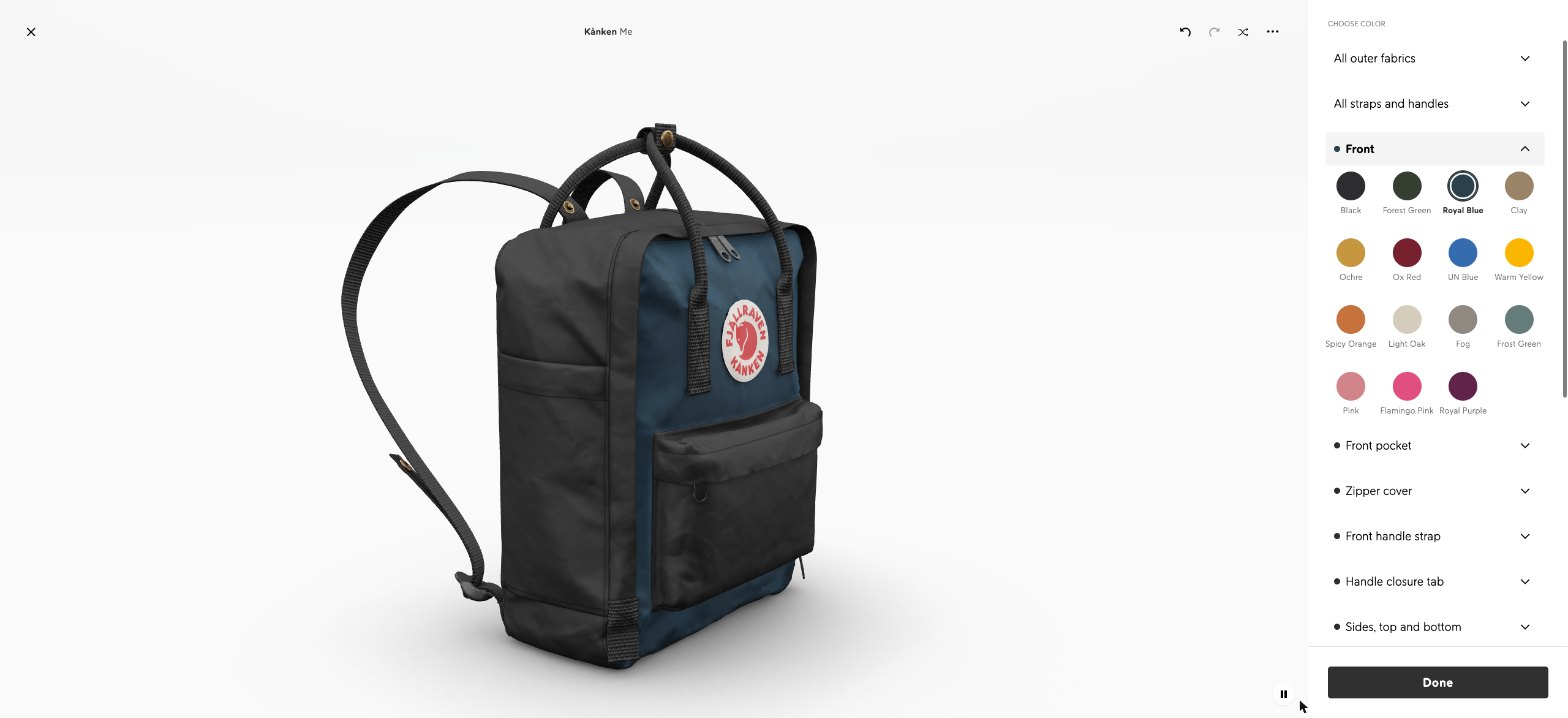
Several brands let customers design their own product: choose colours, materials and details, or order in their own measurements. Fjällräven’s Kånken configurator and Oscar Jacobson’s made-to-measure garments are two examples. The hard part is showing colour and material convincingly on screen.
Houses, pools and other big purchases
For big purchases, the configurator becomes a way to make the choices concrete before the customer talks to a salesperson. Hjältevadshus lets house buyers choose house and options in 3D, and Pahlén does the same for pools.
Computers and electronics
Built-to-order computers are a classic example. The customer chooses processor, memory and storage, and the configurator makes sure the parts are compatible. It is the same logic as in an industrial sales configurator, just with fewer choices.
What B2B can learn from consumer configurators
| Principle | In the consumer configurator | In B2B |
|---|---|---|
| Few choices at a time | One step for model, one for colour, one for options | Split technical choices into steps and hide what is not relevant |
| Only valid choices | Impossible combinations are not shown | Rules and calculations should stop errors before they become an order |
| Instant feedback | Image and price update with every choice | Show the solution, dimensions and price while the salesperson chooses |
| A clear ending | Cart, test drive or quote | Quote, order to ERP or engineering brief |
The difference is that B2B often has more users, more price levels and more complex products. Read more in Configurator for B2B or find out what you need with the needs guide.
Frequently asked questions
What is a car configurator?
A car configurator is a configurator on a car maker’s website where the customer chooses model, engine, colour and options, sees the car and gets a price. It is built on rules that decide which choices can be combined.
Are there configurators for businesses?
Yes. In B2B they are often called sales configurators or CPQ and are used by salespeople, retailers and customers to create quotes with the right rules and prices.
What does it cost to build a configurator?
It depends on the products, the rules, the integrations and whether you need 3D. Read more on the pricing and business value page, where you can also calculate your own value.