Industries · Furniture and interiors
Configurator for furniture and interiors
Shelving, storage and furniture systems are built from many parts. A furniture configurator lets the customer build on their own and makes sure that what is ordered fits together.
In short
- Furniture and interiors are often sold as systems: parts that are combined into something the customer assembles.
- A furniture configurator needs to handle dimensions, rules for what fits together and a price that is correct.
- The hard part is rarely the 3D image, but making sure the result is a correct parts list.
Why furniture suits a configurator
Many furniture and interior companies sell systems rather than finished products. Shelving, wardrobes, sofas and storage are built from side panels, shelves, drawers and accessories that can be combined in a great many ways. That gives the customer freedom, but makes it hard to know what is needed and what it costs.
A furniture configurator moves that work from the customer and the store to the tool. The customer chooses, and the tool makes sure the parts fit together and calculates what needs to be ordered.
Common challenges
- Dimensions and fit. The customer knows how big the wall or niche is, but not which modules will fit.
- Many parts per purchase. A single shelf can be twenty or so items. Miss one bracket and the delivery is wrong.
- Appearance and materials. The customer wants to see colour, wood and proportions before deciding.
- Several channels. The same system is sold in your own online shop, through retailers and in stores.
Which configurator for furniture fits?
| Situation | Often fits | Read more |
|---|---|---|
| A product with variants: fabric, legs, size | Product configurator | Product configurator |
| A modular system built part by part | 3D configurator | 3D configurator |
| The customer plans a whole room or a wall | Spatial configurator (room planner) | Spatial configurator |
| Salespeople and retailers create quotes | Sales configurator | Sales configurator |
Examples
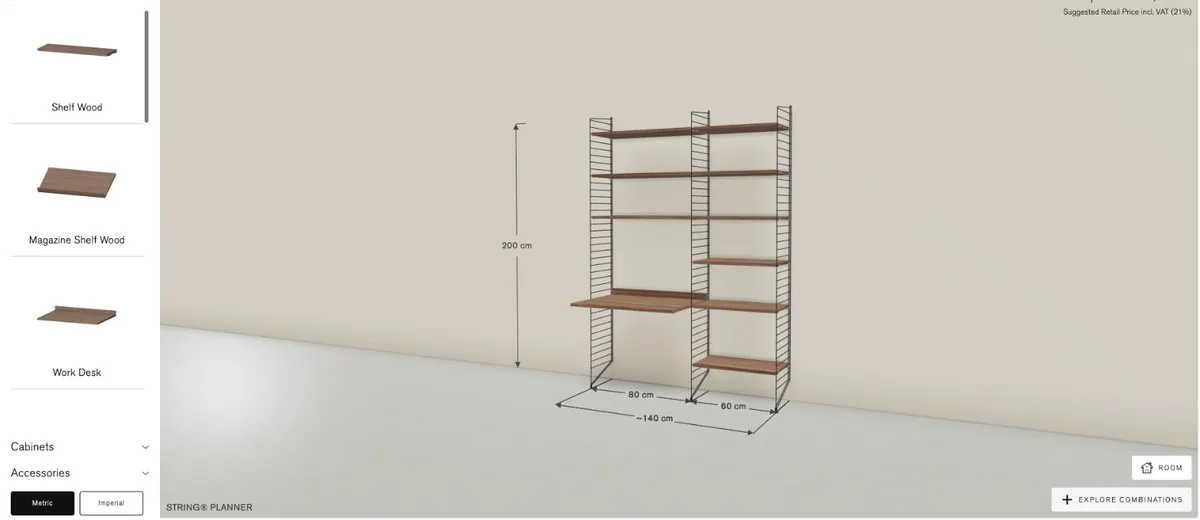
- String: the customer builds their shelf from side panels, shelves and cabinets, sees the dimensions and total price and adds the shelf to the cart.
- Elfa: the customer draws their wardrobe or bookcase in 3D and gets an order list. An example of a room planner.
More projects can be found in Animech’s case collection .
What it takes
- A range where every part has an item number, dimensions and a price in a system you can draw from.
- Rules for what fits together, written so that someone other than the product developer understands them.
- 3D models that are light enough for a phone. CAD files are a good start but need to be simplified.
- A decision on what happens after the last choice: cart, quote or order at a retailer.
Read more in the guides about product data and 2D or 3D.
How to get started with a furniture configurator
Start with one product family, ideally the one that sells the most or generates the most questions in store. Gather the parts, dimensions and rules for that family, and decide what the customer should end up with: a cart, an order list or a quote. Test a first version with real customers before expanding to the whole range. What works for one shelf can usually be reused for the next.
New to the topic? Start with what a configurator is and which types there are, or look up the terms in the glossary.
Frequently asked questions
Does a furniture configurator need to be in 3D?
Not always. A product with few choices often works well with images per variant. 3D adds the most value when the customer builds something from several parts and wants to see proportions and dimensions.
Can retailers use the same configurator?
Yes, if it is built for it. It is common for retailers to get the same tool with their own prices, or for the result to be sent as a quote request to the nearest store.
How are special dimensions handled?
Either as fixed steps, for example widths in whole modules, or as free dimensions within limits. Free dimensions require that production and pricing can handle them.